

In today’s fast-paced digital environment, reaching customers with the right message at the right time is more important than ever. And the best place to reach them is usually their mobile phone—as people spend an average of 4 hours and 37 minutes on their phones each day. Whether it’s for marketing, transactional alerts, or customer support, businesses must choose communication channels that are effective, scalable, and aligned with user expectations.
Two widely used channels for direct communication are push notifications and SMS (Short Message Service). Each has its own strengths and limitations. Another alternative channel is RCS—we discuss the differences between RCS and SMS in a separate article, but here we want to focus on the differences between push notifications and SMS, helping businesses make informed decisions based on their unique communication needs.
Understanding the Basics
What Are Push Notifications?
Push notifications are brief messages that are sent via an app without an active request by the user. They are displayed as banners or alerts on mobile phones’ screens or in browsers. They are typically used to deliver updates, promotional offers, or reminders and are dependent on app installations or website permissions.
What Is SMS?
SMS (Short Message Service) is a text messaging service available on virtually every mobile phone. It is a widely used and simple form of communication, allowing for up to 160 characters per message. Unlike push notifications, SMS does not require an internet connection or a specific app—only a working mobile network.
Push Notifications vs SMS: Key Differences
Here is how push notifications and SMS compare across several relevant dimensions:
1. Reach and Availability
- Push Notifications: Can only reach users who have installed an app or opted into web notifications. Their effectiveness depends on user permissions and app engagement.
- SMS: Available on all mobile devices, regardless of internet connection or installed apps. SMS can reach a wider audience, including users with basic mobile phones.
SMS offers broader reach, while push notifications are ideal for engaging existing app users.
2. Engagement and Open Rates
- Push Notifications: Offer the ability to deliver engaging, rich content (images, emojis, action buttons), but may be ignored if sent too frequently or perceived as intrusive. Originally, they were designed to be used only in emergency cases (e.g., weather updates).
- SMS: Typically has higher open rates, with most messages read within minutes. However, the format is more limited in terms of content design.
Both channels can drive engagement, but success depends on frequency, timing, and relevance of the message.
3. Reliability and Deliverability
- Push Notifications: Dependent on device settings, internet connectivity, and background data permissions. Messages may be delayed or blocked if the app is inactive.
- SMS: Works reliably across all networks and devices, with no need for internet access. Particularly useful for urgent or mission-critical messages.
SMS is often preferred for time-sensitive communications due to its reliability.
4. Cost Considerations
- Push Notifications: Push notifications require a specific app development and setup, but sending push notifications is generally free, making it cost-effective for high-frequency messaging.
- SMS: Involves fees, but our SMS solutions offer competitive pricing with a transparent usage-based pricing model and global scalability.
Push may be more economical for ongoing user engagement, while SMS provides higher ROI for priority messages.
5. User Trust and Perception
- Push Notifications: May be seen as less formal or even intrusive if not used carefully. Opt-in rates vary across industries and demographics.
- SMS: Often perceived as more personal and trustworthy, especially for service updates, confirmations, and security-related messages.
Choosing the right tone and frequency is essential for both channels to maintain user trust.
Use Cases of SMS vs Push Notifications
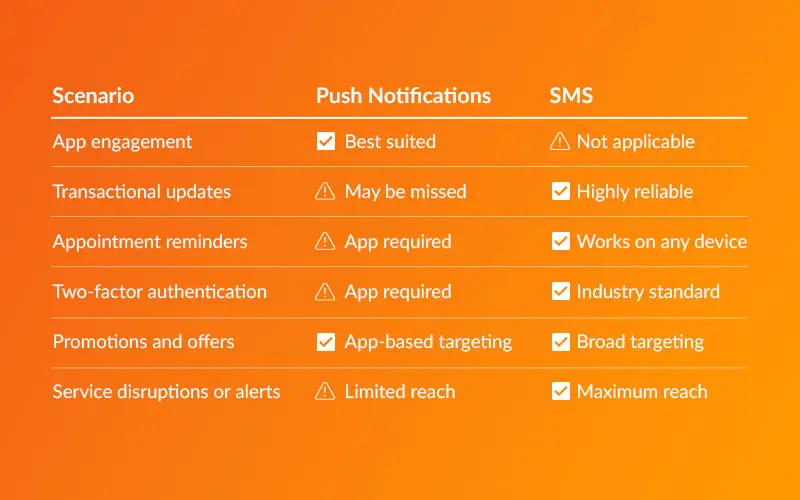
SMS vs Push Notification: Making the Right Choice
Ultimately, the decision between SMS and push notification depends on your business goals, target audience, and use case.
- Use Push Notifications if:
- You have a well-established app or web presence
- Your audience is highly engaged via your app
- You need a cost-effective solution for frequent updates
- Use SMS if:
- You require reliable message delivery
- Your message is time-sensitive or transactional
- You want to reach a wider audience, regardless of device or app usage
For businesses that need consistent, global communication—especially in industries like logistics, banking, retail, healthcare or travel —SMS provides unmatched reach and reliability.
Final Thoughts on Push Notifications vs SMS
The comparison of push notifications vs SMS reveals that both channels have their place in a well-rounded communication strategy. Their value depends heavily on context. Push notifications are effective for engaging users who are already active in your app ecosystem, offering a cost-efficient way to contact that existing base.
However, when communication needs to be reliable, immediate, and universal, SMS stands out. It works on every device, requires no internet connection, and delivers consistently high open rates within minutes. That makes SMS uniquely suited for transactional alerts, security codes, service disruptions, and any situation where speed and certainty matter most.
For businesses seeking to reach customers at scale, across all devices and networks, without dependency on app installs or user settings, SMS remains the most trusted, effective, and versatile channel available.